MDQ scoring: what positive and negative results mean
Updated October 12, 2026 · Reading time: 5 min · 7 sections

Seven Yes responses do not, by themselves, meet the MDQ screening rule. The displayed rule also requires a same-period Yes and moderate or serious problems. I keep those answers separate because combining them into a colorful percentage makes a simple threshold look like a personal prediction.
What makes an MDQ screening result positive?
The self-check on the bipolar test page uses thirteen lifetime symptom prompts and two follow-up questions. For complete responses, the historical three-condition rule asks for at least seven symptom Yes answers, several experiences occurring during the same period, and moderate or serious problems. Every condition must be satisfied. No, minor impact and fewer than seven explicit symptom Yes responses each prevent a complete set from meeting that rule.
The distinction matters because the follow-up questions are not decorative. A list of experiences scattered over different periods is not the same answer as several occurring together. Reporting many experiences with no or minor problems is not the same response as moderate or serious problems. Neither observation lets a website reconstruct the history, duration or clinical significance behind your choices.
| Yes count | Same period | Impact | Displayed rule |
|---|---|---|---|
| 6 of 13 | Yes | Moderate | Not met |
| 7 of 13 | Yes | Moderate | Met |
| 13 of 13 | No | Serious | Not met |
| 7 of 13 | Yes | Minor | Not met |
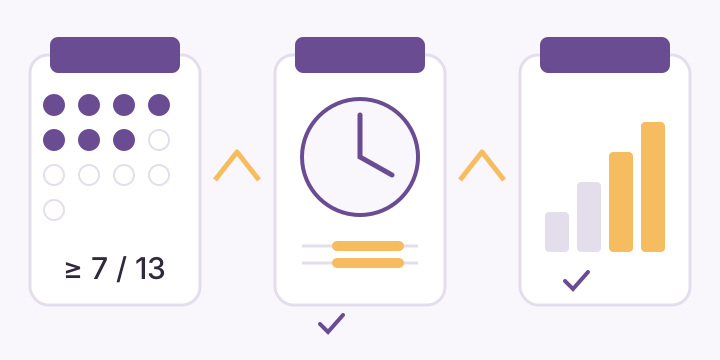
The original MDQ scoring sheet explicitly joins the count, timing and impact conditions.
Does seven out of thirteen mean a chance of bipolar disorder?
Seven divided by thirteen is a fraction of the prompts answered Yes. It is not the chance that you have bipolar disorder. The thirteen items are not independent tickets in a probability calculation, and there is no justification for adding arbitrary percentages for timing and impact. I would describe the output as “seven symptom Yes answers, same-period Yes, moderate impact,” then state whether the displayed rule is met.
A threshold deliberately simplifies a response pattern. A clinical assessment asks questions the threshold cannot answer: what happened, how long it lasted, how unusual it was for you, which consequences followed, and what other explanations deserve consideration. Even an accurately calculated screening result does not turn those unknowns into evidence.
Should I answer about my whole life or how I feel today?
The prompts refer to whether there has ever been a period when you were not your usual self. Answering only about your current day changes the question. Conversely, ordinary variation should not be expanded into a lifetime symptom just because a familiar word appears. Read the whole sentence, including comparisons with your usual behavior and descriptions of noticeable change.
If memory is unclear, uncertainty is useful information. Do not manufacture a definite Yes or No to unlock a result. A professional conversation can examine a concrete period and distinguish your own recollection from something another person observed. You do not need a detailed public account, and you should not use another person's answers to assign them a diagnosis.
What happens if I skip a question or feel unsure?
The website adds Unsure and Prefer to skip for a less coercive interface. These are adaptations, not standard clinical responses. One such choice, or one unanswered prompt, leaves the summary incomplete. The tool shows counts and response details without issuing the full screening conclusion. It never treats a skipped item as No to make the output look finished.
An incomplete set with seven symptom Yes answers is still incomplete when the timing response is missing. A complete set with six Yes answers is a different state: enough information exists to apply the displayed rule, but that rule is not met. Keeping those states distinct prevents “not enough information” from being misread as reassurance.
How should I describe my screening result?
“Positive screening result” means the complete responses satisfy the three-condition rule. It is a reason to discuss assessment, not a declaration that a condition is present. “Negative screening result” means the combination is absent in these complete answers. It does not rule out bipolar disorder, a different condition or a need for help. Neither label identifies bipolar I or II.
The NIMH overview describes diagnosis through the severity, duration and frequency of experiences and a person's history. That context explains why a form cannot supply a diagnosis. This guide provides general information, not individual medical advice. Do not start, stop or alter medication because of an online result.
Are translated MDQ questions clinically validated?
Questionnaires can circulate with different instructions or referral practices. The rule displayed here is explicit so you can inspect it rather than assuming every page labeled MDQ calculates identically. The English prompts retain the site's supplied MDQ-style wording. Navigation, uncertainty options and translations are adaptations; the website does not claim they have been clinically validated.
When a professional uses a questionnaire, ask which version and instructions apply. A browser's visual design cannot establish validation, and accurate software tests cannot establish clinical performance. When reading a result, keep the question wording beside your answers. For example, seven Yes answers with same-period No produce a negative screening result because one required condition is absent. A different result after editing an answer reflects that changed response, not a change in your health.
What should I bring to a mental-health appointment?
- Review the full prompts and correct any misread response.
- Write down the count, timing answer and impact answer separately.
- Note uncertainties or a concrete period you would like to discuss.
- Choose whether individual responses belong in an exported copy.
- Discuss present concerns even if the rule is not met.
Copy and print summaries contain potentially sensitive information. The default omits individual symptom responses and your optional note, but still includes timing and impact. A mood and sleep diary is a separate record and is not included. Keep a copy somewhere appropriate for your situation, and review it before sharing.
Immediate danger or inability to stay safe requires local emergency help, not another pass through a questionnaire. For human emotional support, select your country at Find A Helpline. You never need to reach a threshold before contacting support.
Questions and answers
Does 7 of 13 mean a 54% chance?
No. It describes the fraction of prompts answered Yes, not a personal probability.
Can an incomplete result be negative?
The site does not issue a complete rule conclusion when an answer is missing, skipped or uncertain.
Does a met rule diagnose bipolar disorder?
No. It is a starting point for professional assessment, with important limitations.